
Mangaraho

Type
Altitude
221m
Part of

Introduction
This large volcanic plug has the oldest recorded climb in Northland. Try climbing Slab Route in mountaineering boots with an old rope and next to no pro — just as Peter Clement and George Carr did in 1962. A few climbs were put up in the 1960s and 1970s, usually following obvious cracks or ledges, but the area was virtually forgotten through the 1980s and into the 1990s.
Green Eggs and Ham, put up in 1993 by Paul Hersey and Hugh Nicholson was probably the first route for about 15 years, and generated a growing enthusiasm for what some consider is the best northern climbing area beyond the Mt Eden Quarry. During the mid 1990s interest in the area accelerated, with a mixture of new sport routes and multipitch classics. Of all the climbers who have spent time at Mangaraho, John Maine probably has the closest affinity. He treats it witha respect it deserves — and occasionally demands when you’re three pitches up and unsure which way to go!
Climbing notes
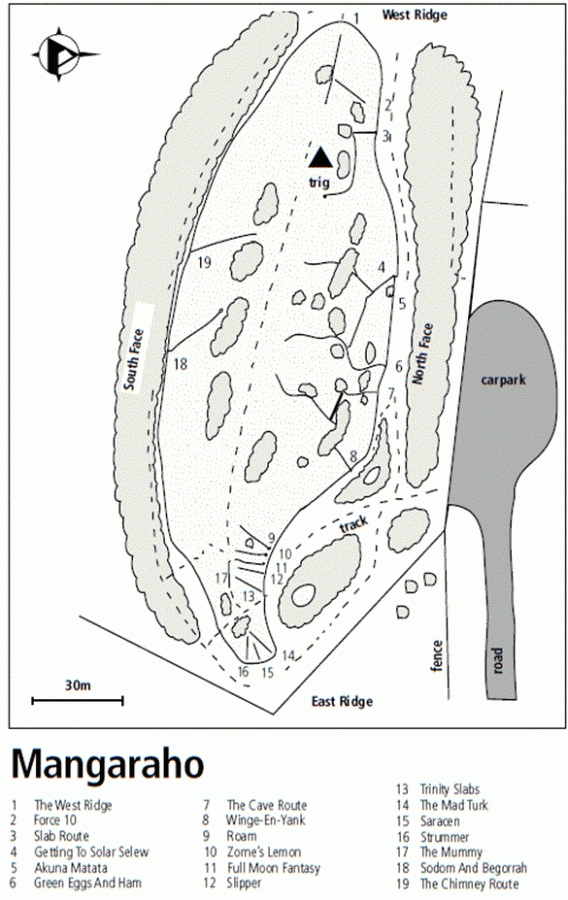
This is a big chunk of rock, and it’s advisable to familiarise yourself with a few landmarks that may help with route-finding before jumping onto the North Face.
Look for the obvious cave on the Cave Route at the right hand end of a large tree covered ledge halfway up the eastern end of the North Face. Confused?
When you spot the cave, a small grassy ledge immediately on its right is the belay point for the end of the second pitch of Green Eggs and Ham.
Further right and down is the large left-leaning crack of The Dihedral.
From the carpark you should also be able to see the freestanding altar-shaped boulder at the northern end of the face.
Route finding abilities are a definite advantage on the North Face, as there is not always a line of bolts to follow. In contrast, the Trinity Slabs area is generally straightforward and a useful introduction. The West Ridge is another popular warm-up route.
The plug is about 120m high, and the rock is generally sound. There are, however, a number of flaky patches, usually close to the ground. Some routes are bolted, but others require a full range of natural pro. There is a mixture of climbs; while some of the older routes are now overgrown andobsolete, others have stood the test of time to be viewed as classics. If tackling a long North Face route, be prepared to be on the climb for over three hours (the first ascent of Green Eggs and Ham took six hours). There is no water nearby, but camping is sometimes allowed by the local landowner. Ask at the house on the left as you turn onto the gravel road.
A final warning: Beware the Mangaraho Possum. On more than one occasion climbers have had to bail from prospective routes due to furry requests from manic marsupials.

Image
Lat/lon
-36.021241,173.976081, NZ Topo Map
Topo50
AY29 879 133
Approach

From Auckland take State Highway One north to Brynderwyn (about 110 km), then turn left on Provincial Highway 12 through Maungaturoto and Ruawai. From Ruawai stay on the road to Dargaville until Tokatoka crag can be seen on your right, directly behind the pub. To find Mangaraho carry on along the main road for another 5 km to the Mititai turn-off. Take this for 10 km up to the base of Mangaraho, turning off onto a gravel road when nearest the plug.
Alternately, from Whangarei drive to Dargaville, then turn left onto Provincial Highway 12 towards Maungaturoto. Follow this for 15 km to the Mititai turn-off.
Both Mangaraho and Tokatoka are large volcanic plugs, easily spotted from the main road. When reaching the Mangaraho carpark, the North Face is directly in front of you.
Add Place Add Route

Routes

Reference Title Grade Length Pro Quality Alert Operations
1 1West Ridge, 14 14 60m
0

  • P1
  • 14
  • 60m
  • Trad

West Ridge 60m
Head up the main ridge
on easy ground and over a rock nose. Scramble
up to the next buttress and belay. A suitable
anchor can be difficult to arrange.
From here there are four variations for the second pitch.


  • P2

For all these variations there are
only natural pro placements, although an old
peg may still exist on Flake Fake.


 Flake Fake, 16 16 30m
0

  • P1
  • 16
  • 30m
  • Trad

Move to an obvious detached flake on the left
of the buttress. Bridge up this, stepping onto
the main face at the top. Follow a thin crack
above, before making the crux move onto sloping
ledges. Follow the line of least resistance
over easy ground to the top.


 Step It, 15 15 35m
0

  • P1
  • 15
  • 35m
  • Trad

Step It 15 35m
From the buttress traverse right for 7 m to an
obvious crack which leads to a large sloping
grassy ledge. Climb the crack by bridging,
and step left onto the ledge. Follow the ledge
till it peters out then make a wide step left to
a protruding foothold and jug. Head up and
slightly right to trig.


 Curly Top, 17 17 30m
0

  • P1
  • 17
  • 30m
  • Trad

Curly Top 17 30m
Traverse as for Step It, but instead of climbing
the crack, continue right across sloping slabs
to a large earthy area. Climb the overhanging
crack (originally aided) on the left and on to
the top.


 Superfly, 16 16 30m
1.02

  • P1
  • 16
  • 30m
  • Trad

Climb the buttress direct, just on its righthand
side, till reaching the same ledge as for
Step It. Good pro here. Finish as for Step It.


2 2Force 10, 20 20 35m
1.02

  • P1
  • 20
  • 35m
  • Trad

The route starts below the West Ridge, and can
be reached by abseiling off the obvious detached
flake at the end of the first pitch of the West Ridge.
Otherwise scramble up easy ground from the
track. Look for a long clean right-leaning cornercrack
which starts part way up the face:
Find a belay stance some way below the crack.
From the belay, scramble up towards a large
ledge on the right, climb directly up the short
wall to the start of the roof crack. Traverse
right using jams and underclings to the lip.
Crux is turning the lip and getting established
in the corner. Follow the crack up and when
it narrows move right to bridge up between
two cracks (two pegs). Exit to the right of the
block. Take cams 0–3, a couple of each size
would be an advantage. Beware of rope drag,
slings instead of quickdraws are a good idea.


3 3Slab Route, 12 12 115m
0

  • P1
  • 12
  • 15m
  • Trad

This was one of the first recorded climbs in
Northland. Originally done in alpine boots
and with none of the “trendy” pro used today,
the route has become somewhat overgrown.
Later attempts have struggled to find the
original line; treat the description with circumspection.
To find the start look for some vegetated guts
down and left from Force 10. The slab is on
the left of the guts and is marked by a quasi
“Z” shaped crack.
Either scramble up some easy
ground on the right and traverse left across a
tree filled gut to the start of the slab proper,
or climb directly up a short steep section
below the slab.


  • P2
  • 40m
  • Trad

Traverse the main slab up and
left past an old bolt, heading for a large cave
on the left.


  • P3
  • 20m
  • Trad

From the cave head up a sloping
slab on the far left of the overhang to a
chockstone filled crack. Climb the crack and
find a belay.


  • P4
  • 25m
  • Trad

Traverse right to a slab then up
to earthy ledges. Head right to a crack then up
easily to summit overhangs.


  • P5
  • 15m
  • Trad

From the top of the crack move
right to a large ledge and sloping slabs which
lead to the summit.


 The Dihedral, 18 18 40m 2
0

  • P1
  • 15
  • 20m
  • 2
  • Trad

To reach the next route head left along the track
past some steep faces (good boulder traverse) to
a large left leaning dihedral. This is the Dihedral
Wall, and is easy to spot from the carpark.
Climb easily up to the
base of a shallow groove a few feet left of the
dihedral. Head up the groove past a fixed nut,
traversing left at the top of a ledge to two bolts.
A bit run out.
From here there are two options for continuing.
Pitch


  • P2
  • 18
  • 20m
  • Trad

From the two bolts head
right to the crack (look for an old wooden
peg from the original attempt). Step right
and follow a series of underclings (1½ cam)
and scoops to a right tending ramp (bolt and
3 cam), then up to chain belay.
The bolts were added by Guy White, Chris
North and Emily Lane in 1996, thinking they
were doing a new route.


5 5Akuna Matata, 19 19 45m
0

  • P1
  • 19
  • 45m
  • Trad

Instead of belaying at the bolts at the end of
the first pitch of The Dihedral, carry on straight
up through some flakey ground (crux) to the
crack (cams). Follow the crack left around a
corner (cams) and up to a piton to belay. To
descend, traverse left and down to a small tree
and abseil off.


4 4Getting to Solar Selew, 22 22 90m 3
1.02

  • P1
  • 18
  • 40m
  • Trad

An enjoyable, airy climb, and the most direct
line on the North Face.
Climb the first two pitches
of The Dihedral, avoiding the belay station at
the end of the first pitch.


  • P2
  • 20
  • 30m
  • 3
  • Trad

Starts to the right of belay
bolts. Climb the face direct past a bush (bolt).
Move up to a ramp (friends) tending left to
reach another bolt. Climb through bulges
(cams and 3 bolts), then follow crack to reach
chain belay next to small manuka bushes.


  • P3
  • 22
  • 20m
  • 1
  • Trad

Up a slab left of the belay,
through a bulge (large cam and 10 hex), to an
easy scramble rightish (bolt) before stepping
onto ramp. More bolts protect the crux — an
overhang surmounted by bridging, then
through a grassy bit to belay on a large rock
to left.


6 6Green Eggs and Ham, 20 20 109m 3
1.02

  • P1
  • 15
  • 12m
  • Trad

About 40m further left is a grassy bank. On the left
is a slabby rock band, and this is the start.
Climb the slab via small
ledges and bridging near the top to a large
grass covered bank and tree belay on left. Not
much pro.


  • P2
  • 18
  • 15m
  • Trad

A difficult to find and
strenuous start on the face below an overhang
till a jug can be reached. Climb up to overhang
(cams), then traverse left on small holds till
the roof can be turned via a jug and small
ledge. Head right to grassy ledge and belay
off small tree.


  • P3
  • 18
  • 30m
  • 1
  • Trad

Head up and right to large
mantleshelf ledge (peg). Continue right and
up over small sloping ledges (nuts and a bolt)
till a tree covered bank is reached. At the next
wall step left onto a shallow corner (bolt)
and follow up and right to large flax and bolt
belay. Can be climbed as two pitches to reduce
rope drag.


  • P4
  • 20
  • 25m
  • 3
  • Trad

Climb straight up past two
bolts then tend left to a bulge with a crack
underneath. Step left past the hangered bolt
and continue up, moving with difficulty past
another bolt. Finish by jamming up a large
crack to an airy bolt belay.


  • P5
  • 17
  • 7m
  • 1
  • Trad

Named “Numb Nutties
Traverse”, head left (past a poor excuse for an
expansion bolt from the first ascent) around
awkward bulges till a belay stance can be
reached.


  • P6
  • 14
  • 20m
  • Trad

Climb up on easy sloping
slabs and cracks to the summit.
Although there are a number of bolts, a
full rack of natural gear, especially cams, is
necessary. Try and pick out the route from
the carpark, as the line is not always obvious.
Plenty of big wall atmosphere, especially on
the higher pitches.


7 7The Cave Route, 17 17 70m
0

  • P1
  • 17
  • 25m
  • Trad

Down at the track walk left for a few metres
where easy rock can be scrambled up to reach the
same grassy bank as for the end of the first pitch
of Green Eggs and Ham. Look for a dirty vertical
crack. This is the start.
Climb the crack to the cave.
The original ascent used aid, but the pitch has
since been freed.
Scramble up and left along the tree covered
ledge past steep walls until a line of least
resistance becomes apparent.


  • P2
  • 15
  • 45m
  • Trad

Head up, right and up
again through broken ground till the top is
reached. Can be broken into two pitches to
avoid rope drag. A pleasant enough climb, all
on natural pro.


8 8Winge–En–Yank, 20 20 35m
0

  • P1
  • 20
  • 35m
  • Trad

From behind the boulder move up into a steep
fingery layback to small ledge (2½ or 3 cam).
Good pro (2 cam) on the left as you get out
around the arete at two-thirds height and up
to belay off trees.
This route may extend and complete the 1972
attempt at the same site by Pete Jemmett and
Robbie McBirney, labelled Hang It.


9 9Roam, 17 17 55m 10
1.02

  • P1
  • 16
  • 55m
  • 10
  • Trad

Looking up to the saddle this route follows a
line of bolts tending right up the slabs.
Follow the line of bolts heading
right and up. About 10 bolts and chain belay.
Rope drag gets awkward near top of pitch.


  • P2
  • 17
  • Trad

Pitch 2 (17): From belay climb the crack on
the right and follow the bolts above the chain
belay. A nice varied route once past the flakey
rock at the start.


10 10Zorne’s Lemon, 16 16 45m 10
1.02

  • P1
  • 16
  • 45m
  • 10

The line of bolts that go straight up to the
saddle. Advisable to use double ropes or long
slings to avoid rope drag. Crux is moving right
near the top. Belay off iron spikes at saddle.


11 11Full Moon Fantasy, 22,A1 22,A1 40m 5
1.02

  • P1
  • 22
  • Aid A1
  • 40m
  • 5
  • Trad

Just left of Zorne’s Lemon, this route meanders
somewhat, but double ropes will reduce
rope drag. Two bolts and slabby moves lead
to cam placements and a short, steep wall.
Strong moves up then delicate traverse right
past two bolts to a rest. Step up and left, find
an undercling and clip the bolt under the
overhang. The next move has yet to be freed
but, using the bolt for aid, make a difficult
reach to the horizontal crack. Traverse left on
strenuous underclings to a bolt, breathe, then
delicately up the corner to a small grassy ledge.
Two more bolts and fine moves lead to top and
chain/tree belay.


12 12Slipper, 18 18 20m 1
0

  • P1
  • 18
  • 20m
  • 1
  • Trad

Down and 20 m left of Full Moon Fantasy is a
prominent angled groove. Climb the groove
and at the top move left into a shallow depression
(crux). Climb the depression to a bulging
wall, make a difficult move right around the
arete and up to the second bulging wall. Climb
the thin crack in the wall to finish at a bolt on
Trinity Slabs. Not a lot of pro.


13 13Trinity Slabs, 16 16 50m
0

  • P1
  • 16
  • 35m
  • Trad

About 6 m left of Slipper is the lowest point of
the slabs, near the track.
From the lowest point
follow a shallow groove to a small ledge.
Continue up another groove to a peg and cam
placement. Step down and left onto a flake and
ascend the awkward bulge to a small grassy
ledge. Run out up the corner crack above and
traverse right to a bolt (replacing the original
rusted peg). Move past the bolt onto short
slabs, tending right past another bolt. At the
base of a large slab with a left slanting crack,
scramble left and up through the bush to belay
at the start of the next headwall.


  • P2
  • 16
  • 15m
  • Trad

Climb the steep wall via
horizontal breaks (bolt) then follow easy
sloping ground to large rock belay.


17 17The Mummy 20m
0

  • P1
  • 20m
  • Trad

Carry on up the track, and at the top turn left to
drop down to the top of the climbs on the East
Ridge area. Turn right and up the ridge.
Ungradeable (dependent on footwear) but
a fun slab. Provides access to the top of the
Trinity Slabs area. It sort of looks like a mummy
from side on if you squint your eyes and
imagine.


14 14The Mad Turk, 16 16 40m 3
1.02

  • P1
  • 16
  • 40m
  • 3
  • Trad

To find the next se of routes, take the track that cuts
round the bottom of the East Ridge area.
Start at the lowest point on the right-hand
side, climb the face and a couple of short awkward
slabs. The top half has been retrobolted:
follow the bolts left and up on nice slab moves.
Chain belay.


15 15Saracen, 22 22 25m 2
0

  • P1
  • 22
  • 25m
  • 2
  • Trad

Climb the middle of the face up to and past
the bolts to chain belay. Can avoid the crux
by moving left for a few metres. Makes the
grade 18.


16 16Strummer, 15 15 20m
0

  • P1
  • 15
  • 20m
  • Trad

Starts high up on the left-hand side of the
face. Climb the buttress to tree filled ledges,
then up the bulge (originally aided) and easier
ground above.


18 18Sodom and Begorrah, 13 13 80m
0

  • P1
  • 13
  • 80m
  • Trad

The next routes are found on the South Face:
Sodom and Begorrah 13 80m
Where the track passes some bushy slabs, climb
behind the bush and up till an apparent line
is reached. Climb the shallow groove to the
right and follow a series of greasy slabs, grassy
guts and ledges, taking the line of least resistance.
The route can be greasy and wet. Not
an obvious line.


19 19The Chimney Route, 14 14 40m
0

  • P1
  • 14
  • 40m
  • Trad

A more obvious climb further along the track.
Left of an overhang is a large angled cleft and
slabs. Climb this, and scramble through scrub
to the top.


Comments
Attribution
By Paul Hersey
UUID
 
7850fdde-7439-43cb-879f-34def84e4238